How Much Do Plantation Shutters Cost in Florida?
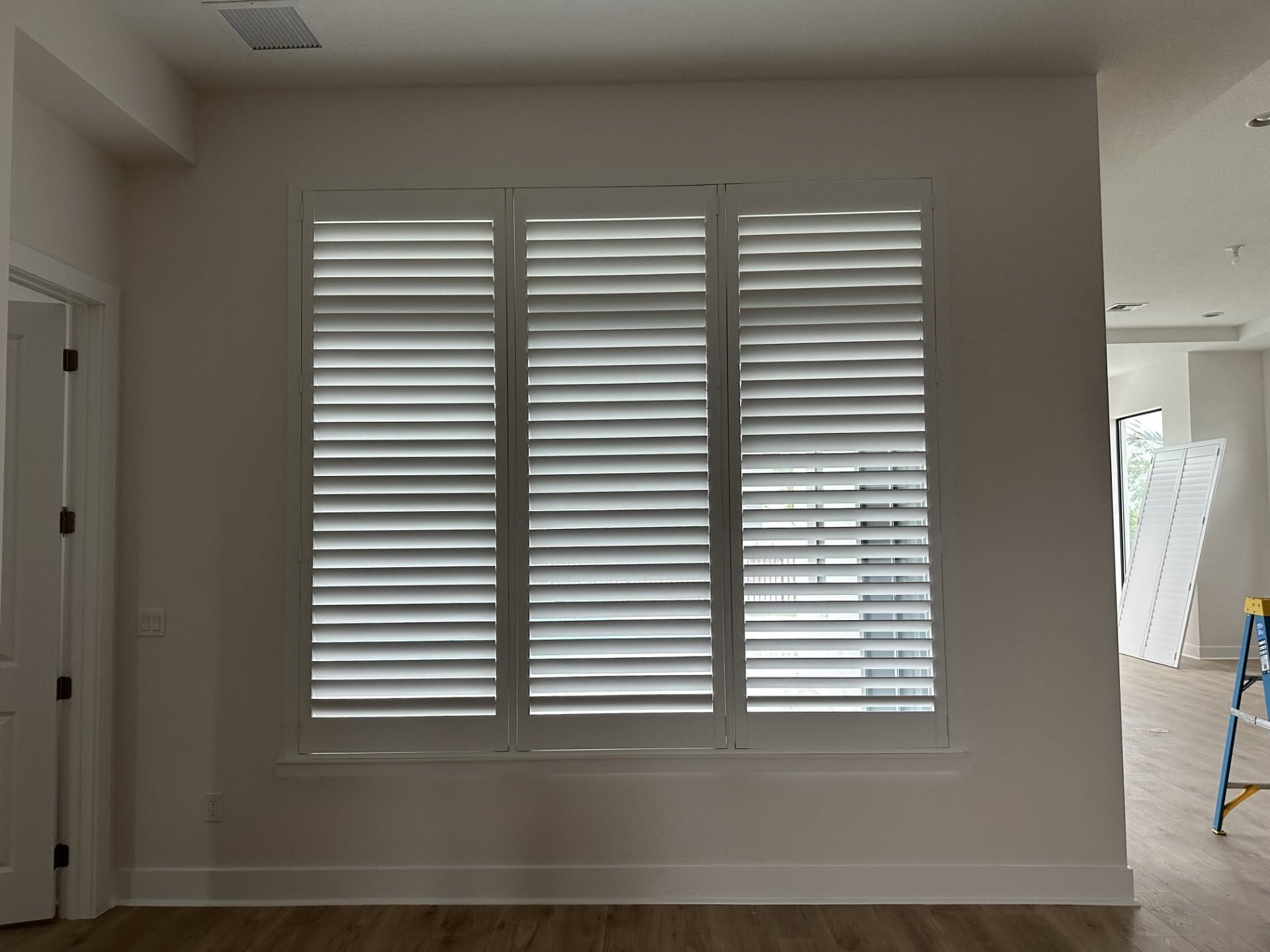
Custom plantation shutters can cost a few hundred dollars for a small, straightforward window and much more for a large opening, sliding door, arch, or multi-window wall. For national budgeting context, HomeGuide’s 2026 guide places many installed interior shutter projects between $150 and $800 per window, depending on size and material. That range is real—and so broad that it is not a reliable quote for a specific Florida home.
A “window” is not a unit of measurement. A 24-by-36-inch bathroom opening and a 96-inch-wide living-room opening are both one window, yet the second may use several times the material, panels, hinges, frame, and installation time. Real wood, poly, composite, custom paint, door tracks, and specialty shapes also belong in different pricing categories.
The useful answer is that custom shutters are generally priced from measured area, then adjusted for material, design, finish, manufacturing, and installation. This guide shows where the money goes and how to compare quotes fairly in Palm Beach, Martin, St. Lucie, and Indian River counties.
Quick answer: Online averages can help set a rough budget, but the final cost of plantation shutters depends most on total square footage, material, panel construction, frame, finish, window shape, door or specialty hardware, and what the installer includes. Compare written specifications—not price per window alone.
Why plantation shutter prices vary so much
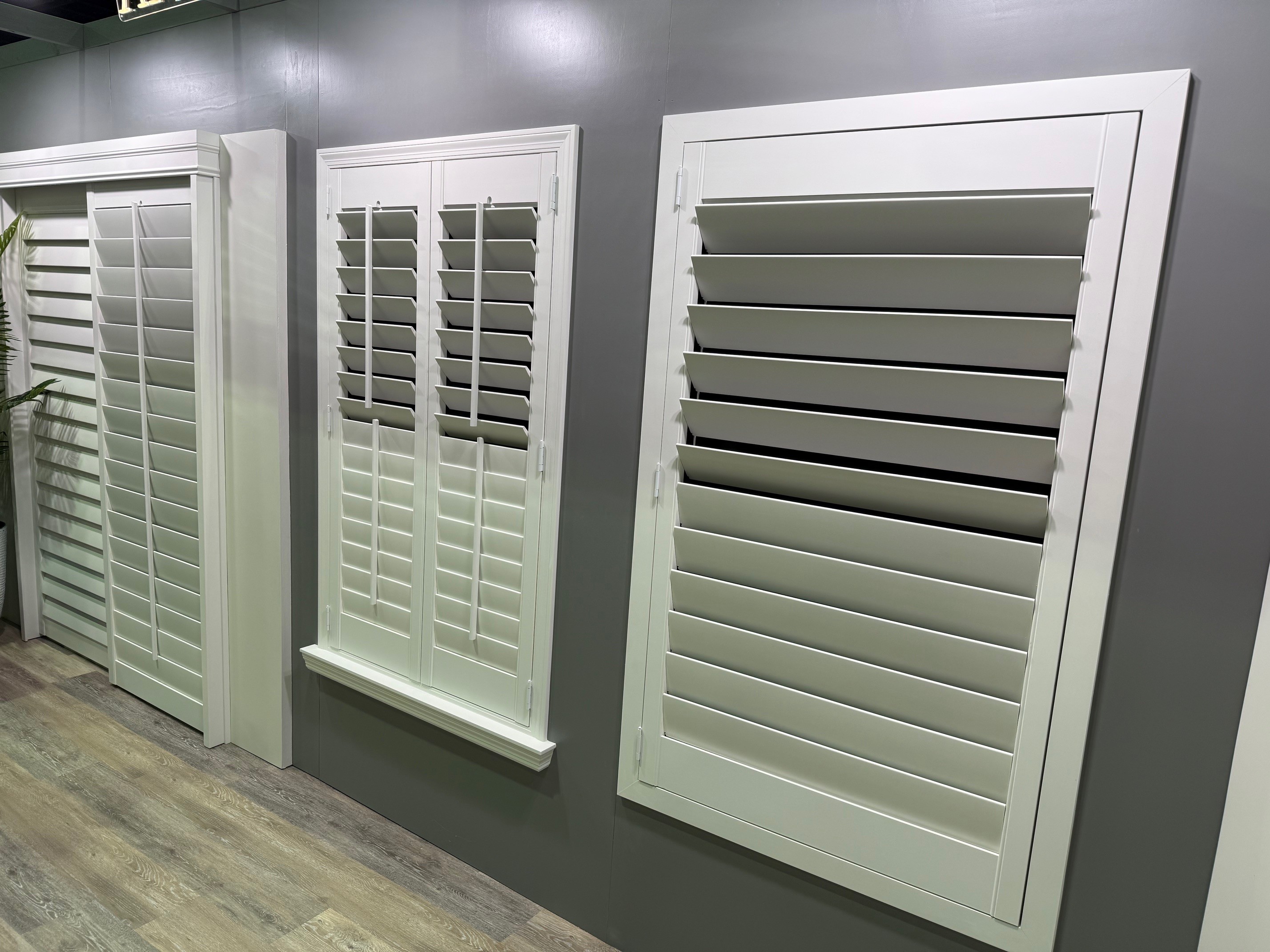
Plantation shutters are closer to fitted millwork than to a boxed blind. The frame must fit the opening. Panels need correct width, height, and hinge support. Louvers must close and remain aligned. The finish is visible in changing daylight. A special shape may require a template and individual fabrication.
Two estimates can therefore describe different products even when both say “white plantation shutters.” One may be imported PVC with standard color and several narrow panels. Another may be locally made basswood with fewer panels, a custom-matched finish, installation, and local repair service. Neither description alone proves value; it explains why totals cannot be compared without details.
Florida projects add their own conditions. Wide sliders, arched transoms, impact-window frames, deep or shallow drywall returns, waterfront views, and hot east or west exposures influence the recommended design. Travel distance and jobsite access can affect installation. Local sales tax and business overhead are included differently among quotes.
The national price range—and its limits
HomeGuide’s current plantation-shutter cost overview reports an installed national range of roughly $150 to $800 per window, with wood generally above entry-level vinyl. Use that only as an orientation point. It combines different regions, materials, window sizes, service models, and installation standards.
A per-window national average may understate:
- Tall or wide great-room windows.
- Sliding and French doors.
- Arches, circles, triangles, and angled openings.
- Premium hardwood or custom finishes.
- Work requiring difficult access or unusual framing.
It may overstate a small, square opening in a larger project with a standard finish. The closer your windows are to average size and simple geometry, the more useful a broad average becomes.
Do not treat a national range as a local company’s advertised price. Labor, manufacturing, freight, material, and service conditions change. A measured estimate is the only way to know what your actual design will cost.
How square-foot pricing works
Many shutter estimates begin with the area of each opening:
Width in inches × height in inches ÷ 144 = square feet
A window measuring 36 inches wide by 60 inches high contains 15 square feet. A 72-by-80-inch opening contains 40 square feet. If a provider uses a base square-foot rate, the larger opening begins with much more material before any design adjustments.
Ask how rounding works. Some companies use exact area; others apply a minimum square footage per opening or round dimensions. Small windows can cost more per actual square foot because every opening still requires a frame, hardware, measuring, fabrication setup, installation, and service.
The base rate may or may not include:
- Frame and trim pieces.
- Standard hinges and tilt mechanism.
- Paint or standard color.
- Delivery and installation.
- Removal of existing treatments.
- Sales tax.
- Freight or fuel charges.
- Specialty-shape or door surcharges.
Square-foot pricing is useful only after those inclusions are defined.
Cost factor 1: material
Material affects raw cost, production method, weight, finish, panel dimensions, freight, and repairability.
Real wood
Custom wood is often positioned above entry-level vinyl and composite because of material selection, joinery, sanding, and finishing. Basswood is valued for its stability and strength-to-weight ratio. Stain-grade components require more careful color and grain selection than opaque paint-grade material.
Wood pricing also reflects finish quality. A furniture-style process with surface preparation, multiple coating steps, curing, and inspection is different from applying a simple coating to assembled parts. Custom color matching may add sample work and setup.
Poly or vinyl
Poly can be cost-effective in standard shapes and colors, but premium reinforced products may overlap with wood pricing. Freight can increase with heavy components. More panels or hinges may be needed for large openings, affecting the total design.
Composite
Composite spans a wide range, from MDF-style products to engineered blends. Some are budget-oriented; others are premium branded systems. Ask what the material contains, how it handles moisture, and what panel sizes are allowed before assuming “composite” occupies a fixed price tier.
For performance differences beyond price, read the real wood vs. poly shutter comparison in this series.
Cost factor 2: window size and quantity
Size usually drives the largest share of cost because it determines material area. Quantity matters, but not every additional window adds the same amount. Ten small bedroom windows may use less material than three walls of oversized glass.
Larger projects can sometimes reduce the per-opening burden of travel, measuring, delivery, and setup. That does not mean the shutters themselves become inexpensive; it means fixed project costs are spread across more area.
Create a window schedule before requesting quotes. Give each opening a simple name—kitchen sink, primary bedroom east, living room slider—and record approximate width and height. The installer will take final measurements, but your list helps confirm that every quote covers the same scope.
Cost factor 3: panel count and engineering
Panels are the hinged moving sections within the frame. A wide opening may use two, three, four, or more. Each panel adds stiles, joinery, hinges, alignment work, and installation adjustments. At the same time, using too few panels can exceed safe dimensions or create heavy, awkward operation.
The lowest panel count is not automatically the lowest appropriate cost. A broad wood panel and a narrower reinforced poly panel have different material and hardware requirements. Door panels may need tracks, floor guides, or extra reinforcement.
Ask the quote to state panel count and hinge arrangement. A lower-priced proposal with four view-obstructing stiles is not equivalent to a two-panel design that safely spans the opening. Conversely, do not pay for an oversized panel that ignores the maker’s own engineering limits.
Cost factor 4: louver size, divider rails, and tilt system
Standard louver sizes may be priced alike, but that varies. Very large or specialty louvers can change component use and depth requirements. A divider rail adds a horizontal structural member and creates separate louver sections. It may be included in standard pricing or treated as an option.
Traditional center tilt, offset rods, and hidden or rear-tilt mechanisms involve different hardware and assembly. Some companies include hidden tilt; others charge an upgrade. The price difference is usually smaller than the effects of material and size, but across a whole home it can add up.
Choose these details for function and style, then price them consistently across quotes. If one provider includes hidden tilt and another lists center rods, ask each to price the same choice.
Cost factor 5: frame and mounting conditions
An inside-mount shutter in a deep, square opening can be straightforward. An outside mount over uneven trim, a corner window, a bay, or a shallow impact-window frame may require different profiles, build-out strips, filler, or scribing.
Frame width and detail affect material use and appearance. Decorative profiles may cost more than simple frames. Color-matching the shutter frame to existing trim can add finishing work.
The installer should also account for handles, cranks, alarm sensors, locks, and tilt-in window functions. Moving or adapting hardware may be included, excluded, or assigned to another trade. Clarify this before comparing totals.
Cost factor 6: paint, stain, and custom color
Standard white or neutral finishes usually offer the most predictable pricing. A custom paint match may require a sample, approval, separate coating batch, and touch-up material. Stain work adds grain selection and more visible variation; premium or multi-step finishes can increase labor.
Do not judge finish from a digital image. Approve a physical sample near the trim, cabinetry, and wall. Ask whether the quote includes the sample process and whether the warranty covers color change, peeling, or normal variation.
Finish systems vary, so compare coating details, sample approval, touch-up procedures, and care instructions rather than assuming every painted shutter is equivalent.
Cost factor 7: specialty shapes
Arches, circles, triangles, eyebrows, trapezoids, and angled windows cost more because area is a poor measure of fabrication complexity. The maker may need a physical or digital template, custom frame geometry, hand-fitting, special louver layouts, and additional installation time.
Ask whether the louvers will be operable or fixed. A fixed decorative fan may cost less than a fully operable arch. Confirm whether the shutter opens for glass cleaning and how it aligns with nearby rectangular units.
Photographs of similar completed work are valuable. A low specialty-shape price is not a bargain if the frame does not follow the window or the louvers are arranged awkwardly. See examples of custom specialty-shape shutters before approving the design.
Cost factor 8: French doors and sliding glass doors
Doors are quoted differently because they need operating systems beyond ordinary window hinges.
French-door shutters may need handle cutouts, projections, hold-open hardware, and careful clearance between paired doors. Sliding-door shutters may use bypass tracks or bi-fold panels, plus valances, guides, handles, and floor or ceiling attachment.
Track quality affects daily use. Ask whether the door system can be removed for glass or hardware service, how panels stack, and what floor clearance is required. The quote should state the number of panels, track type, fascia, hardware finish, and installation conditions.
Cost factor 9: manufacturing location and service model
Imported and domestic shutters can both be well made. The business model changes cost and service.
An imported factory may achieve scale and lower production prices but add freight, long lead times, and remote warranty procedures. A local manufacturer carries local labor and facility costs but may shorten the chain between measuring, fabrication, installation, and repair. A dealer may provide excellent design and service while relying on a national factory.
Ask who is responsible at each step:
- Who measures the openings?
- Who creates the engineering and panel layout?
- Where are the shutters made?
- Who installs them?
- Who returns if a panel needs adjustment?
- Where do replacement parts come from?
Price includes the product and the process around it. Decide how much local accountability and turnaround matter to you.
Cost factor 10: installation and jobsite conditions
Professional installation should include protecting the work area, placing frames square and level, hanging and aligning panels, adjusting louvers and catches, filling appropriate fastener points, cleaning the shutters, and explaining operation.
Costs may increase for very tall openings, stair landings, concrete or masonry conditions, difficult parking or elevator access, occupied construction sites, or coordination with painters and window installers. Most standard residential openings are routine, but unusual access should be disclosed before the order.
Ask whether installation is performed by employees or subcontractors and whether labor is included in the warranty. A “materials-only” online price should never be compared directly with a measured, delivered, installed, and serviced project.
What a complete quote should include
A useful plantation shutter estimate should list:
- Number or name of each opening.
- Measured or billable square footage.
- Material and, for wood, species or grade.
- Louver size.
- Frame profile and mount.
- Panel count and hinging.
- Tilt mechanism and divider rails.
- Paint, stain, or color.
- Specialty-shape or door details.
- Removal and disposal of existing treatments.
- Delivery, installation, tax, and other fees.
- Deposit and payment schedule.
- Estimated production and installation timeline.
- Product, finish, hardware, and labor warranties.
- Service process after installation.
If a quote is one line with only a total, ask for the missing specification. A detailed estimate protects both homeowner and provider because it records what is being built.
How to compare two shutter quotes fairly
Put the estimates side by side and normalize the differences.
- Confirm both include the same windows and doors.
- Compare total measured square footage, not only window count.
- Identify the exact material.
- Compare louver size, frame, panel count, and tilt system.
- Check whether color is standard or custom.
- Separate specialty work and door systems.
- Add tax, freight, removal, and installation if omitted.
- Compare timelines and who performs service.
- Read warranty exclusions and labor coverage.
- Ask why any major price difference exists.
A provider should be able to explain the difference without attacking competitors. Sometimes one quote includes better specifications; sometimes it includes extras you do not need; sometimes the business simply has a different cost structure.
Ways to control the budget without buying the wrong product
Prioritize problem rooms
Start with windows where privacy, glare, heat, or appearance causes the most frustration. Keep a record of the chosen color and details for future phases.
Use a standard finish
If a standard white coordinates well with the trim, it can avoid custom-color setup. Do not accept a poor match merely to save a small amount on a permanent feature.
Simplify where the window allows
A straightforward frame and tilt system can reduce options without reducing core construction. Eliminate decorative upgrades that do not support the room.
Coordinate related work
Complete window replacement, trim repair, and painting before final shutter measuring when possible. Remaking shutters because the opening changed is far more expensive than sequencing the work correctly.
Phase consistently
If the whole home exceeds the current budget, complete one elevation or group of rooms at a time. Confirm that the material and finish will remain available and understand that future pricing may change.
Avoid reducing cost by pushing panels beyond recommended limits, skipping necessary frames, or choosing an unknown material. Those changes affect performance, not just appearance.
Frequently asked questions
Are plantation shutters priced per window or per square foot?
Many custom projects begin with square footage, but companies present quotes differently. Minimum charges, material, frames, panel design, doors, and shapes can change the total. Ask for measured area and included features.
Why do two same-size windows cost different amounts?
One may need a different frame, more panels, a divider rail, custom color, difficult access, or specialty hardware. Ask the estimator to identify the difference.
Is real wood always the most expensive material?
Not always. Entry-level vinyl is commonly less expensive, but premium reinforced poly and composite systems can overlap with wood. Species, finish, size, freight, and brand all matter.
Do custom shutters add value to a home?
They are durable, fitted features that may appeal to buyers, but resale value varies by home and market. Choose them first for daily function and design rather than relying on a promised return percentage.
Is professional installation worth including?
For custom shutters, accurate measuring and installation are central to fit, panel alignment, and warranty responsibility. Skilled DIY installation is possible with some products, but compare the full risk and service terms—not only labor cost.
How long should a quote remain valid?
The estimate should state an expiration date because material, freight, and labor prices change. It should also state whether the price can change after final measuring and what happens if hidden conditions are found.
The bottom line
The cost of plantation shutters is the cost of a specific design fitted to specific openings. National averages can establish a rough starting range, but they cannot tell you whether your home needs two panels or four, a standard frame or a build-out, a simple rectangle or a hand-templated arch.
The most budget-friendly process is to define the material and design you actually want, obtain complete written quotes for the same scope, and resolve construction questions before fabrication. That prevents a low headline price from becoming an expensive mismatch.
Homeowners in Palm Beach, Martin, St. Lucie, and Indian River counties can use this guide with any shutter provider. Keep each estimate until you can explain the differences in square footage, material, panel count, finish, installation, and warranty. If the totals still cannot be compared, ask for a revised written scope before choosing—not a faster sales presentation.